
| tag | Licenses | copyright | copyright2 | link | ||||||||
|---|---|---|---|---|---|---|---|---|---|---|---|---|
|
CC ND & BSD-3 |
© 2025 Phovos https://github.com/Phovos/Morphological-Source-Code
|
© 2023-2025 Moonlapsed https://github.com/MOONLAPSED/Cognosis
|
[/profile/README.md](/profile/README.md) |
Organizational-vehicle for deploying Morphological Source Code to to the world of work and finance, business logic and the contemporary market.
A CPython standard-library-only framework for morphological computation with hermitian type semantics Welcome to the root of the Morphological Source Code (MSC) repository!



CommunityLinks: r/Morphological | Phovos@X | Phovos@youtube | Code of Conduct
NEW: r/Quine; | production gitter(dev-chat)
© 2025 Quineic https://github.com/Quineic/Source | CC ND && BSD-3 | SEE LICENSE
© 2024-25 Phovos https://github.com/Phovos/Morphological | CC ND && BSD-3 | SEE LICENSE
© 2023-25 Moonlapsed https://github.com/MOONLAPSED/Cognosis | MIT/BSD
---
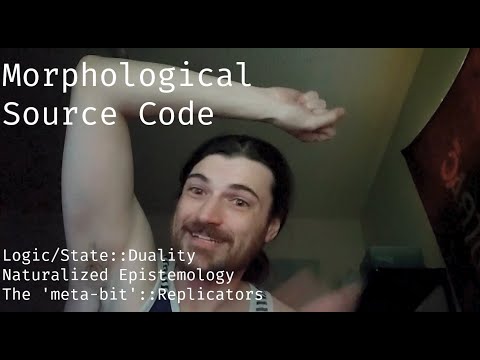
title: "Ontological Relativity & AI Singularity: Convening Epistemic Dualities and Morphological Source Code"
url: "https://www.youtube.com/watch?v=ecQevCn-fcI"
description: |
We need to talk more about the singularitie(s). The greats of the 20th century appear to have melted their darling wings on the sun of the pre-y2k information-age. I don't understand why the great philosophy of the past 50 years hasn't been about the digital/analogue singularity its the most important thing I can think of other than the intrinsically human singularities like time and cognition. I posit that we could have got started with the machine learning revolution 50 years ago and that we have more or less had the tools this whole time. It's not truly an engineering (consumer product/chipset), its an ontology problem - the truly dualistic data structure can reverse its own logic and give the chip blue prints straight to the fab, cutting out a few steps.

#Quine, #MorphologicalSourceCode, #Cognosis, #LLM, #Epistemology, #Philosophy, #ComputerScience, #Phenomenology, #FunctionalProgramming, #OpenAI, #Anthropic, #Strawberry, #Q*, #QStar, #Pathfinding, #Entropy, #QuantumInfoDynamics, #MetaProgramming, #MetaLanguage, #Singularity, #Ontology, #MachineLearningRevolution, #Cognition, #neuroscience, #ai, #ml, #machinelearning, #transformers, #replicatiors, #quine, #quines

0:33 wave/particle duality
3:00 free energy principle
5:00 observer observing a free energy differential field equation
6:23 P=NP reiteration, 'a field' of information
7:20 Observation collapsing the wave function of the global wave function
9:20 Cognition and extensive quantum entanglement
10:10 The 'bit' of (analogue) information
10:45 Jung and the collective unconscious
11:56 Plato and 'the cave wall' prerequisite of so-called language
12:29 Artificial truths, meta languages
12:47 <explains the arm singularity metaphor>
13:33 State/Logic duality
15:49 (double)Ontological Relativity
16:12 Blackbox Ontological Relativity
16:30 & The cognitive singularity
18:35 "Path Integral" (I'm sorry Dr. F, I will change this nomenclature)
18:58 ..is a singularity
19:16 Jungian binary?
19:45 Crystals??
20:30 Translation using meta language heuristics
21:10 'Object oriented' "Lo! It rabbiteth!"
22:28 "Path integral" -> "Quine/ModifiedQuine/Replicator"
23:10 Replicator is the 'meta-bit'
23:39 (irritating noise, sorry)
24:22 Agentic/Linguistic relativity
25:15 Double relativity ---- The agentic milieu is relative (intensive in thermodynamic char, despite burning heat to exist)?
26:00 Reiterate double relativity ----- 'Computational frame', 't=0 abstraction (implying a differential causal entanglement medium/milieu)'
28:20 Naturalized Epistemology
29:10 After much ado: "Morphological Source Code"
29:40 Informational 'meta-bit' reiteration (replicator)
30:21 Signal Processing compare and contrast
31:08 Continuous Variable Decomposition (Fourier Transform)
32:00 Reiterate what "Path integration [Quine/ModQuine/Replicator - versus Von Neumann-Turing conventional computational causal program planning (the 'morphological' aspect)]" is
32:24 Reversibility/self-reference singularity (meta CICD, 'crystal' [directed acyclic graph] structure)
33:00 'Work' & thermodynamics of information, language, or state/logic dualities
34:15 Morphology of the informatics singularity: "Path integration"
35:15 Functional programming meta paradigm of state/logic duality - modeled as a differential equation or evolutionary system
36:45 The phenomenology of double relativity observer(less) singularities
38:25 Harmonic time-abstracted / differential equations (signal processing analogy in reverse) '
38:55 replicators and cognitive systems speculative architecture
40:28 Quine/Replicator architecture
41:22 Replicatory holography
42:11 Possible causal 'triparte' - the code we had (git), the code we have(runtime), and the code we want (conclusion of and then reinstating of)
42:40 Replicator speculative thermodynamics of dynamical situations
44:00 reiterate/state quasi hypothesis about 'intensive' character of the computational moment abstracted as a differential equation
45:30 'live' programming example - I promise I'm a better coder when the camera isn't on
---
title: "Morphological Source Code & Quineic Statistical Dynamics Yoneda-Lemma/Matrix-Mechanics Arity-fulcrum"
url: "https://www.youtube.com/watch?v=I-DIj-G9pEQ"
description: |
Logical arity is seemingly the fulcrum of multiscale epistemological so-called emergence, broadly, 'information'. This would imply that Category & Morphism are fundemental, while Set is emergent. Heisenberg, Dirac, and Yoneda give us the formalism for such an ontology.
0:00 start
26:00 finThis section is not a tutorial, not a proof, and not a specification. It is an epistemic orientation document describing how MSC/QSD should be read.
MSC/QSD adopts a relational, morphism-first epistemology:
- Observables precede states
- Transitions precede sets
- Meaning is derived, not assumed
This orientation is inspired by:
- Heisenberg’s matrix mechanics (observables as transitions)
- Dirac’s representation-independent formalism
- Category-theoretic morphism primacy
- Practical constraints of computation, thermodynamics, and observability
Readers looking for:
- APIs → see
/src - Formal specs → see
/docs - Philosophy → see the essays below
What follows is a conceptual RFC explaining why MSC/QSD is structured the way it is.
Heisenberg’s original insight (1925):
“One ought to concentrate one’s attention on things which are grossly connected with what one can observe.
The things one can observe, being each related to two states, are expressed naturally as a matrix-array of numbers.
One should consider the whole set of numbers, together.”
Things one can observe are relations between states, not isolated values.
Observable = ⟨m|X|n⟩ (transition amplitude)
An observable is not a number; it is a relation between two states.
X = { x_mn | for all m, n }
The observable is the matrix: the totality of possible transitions considered together.
By diagonalizing a given observable matrix, we obtain:
X |n⟩ = λₙ |n⟩
The eigenvectors define states relative to that observable.
States are not primitive entities; they are derived as stable patterns under measurement.
The set { |n⟩ } is not foundational in itself.
It is an operational equivalence class induced by a measurement context.
Operational corollary (Heisenberg–Dirac):
Sets are not epistemologically primitive.
Operationally meaningful sets are derived from observables (transitions).
This is not a claim about mathematical foundations; it is a claim about how structure becomes observable.
| Set Theory (ZFC) | Matrix Mechanics | MSC/QSD |
|---|---|---|
| Start with ∅ | Start with observables | Start with morphisms |
| Elements first | Relations first | Morphisms first |
| Static | Dynamic | Morphogenetic |
| Sets primitive | States contextual | Sets emergent |
Heisenberg (Matrix Mechanics):
- Observables = matrices
- States = vectors
- Evolution = matrix multiplication
Schrödinger (Wave Mechanics):
- States = ψ(x,t)
- Observables = operators
- Evolution = differential equations
They are mathematically equivalent, but Dirac’s bra–ket notation makes explicit that:
Matrix mechanics is representation-independent,
while wave mechanics is representation-dependent.
This distinction motivates the computational analogy below.
Analogy (epistemic, not ontological):
Matrix mechanics : wave mechanics
::
MSC/QSD           : set-theoretic computation
In MSC/QSD, the primitive observable is a binary transition:
Morphism = bw₁ ⊕ bw₂
You do not observe a ByteWord in isolation; you observe how it transforms relative to another.
T_ij = bw_i ⊕ bw_j
This table plays the same epistemic role as Heisenberg’s observable matrix: the totality of possible transitions considered together.
Define an equivalence relation:
bw ~ bw' iff their XOR-transition profiles are identical
The resulting equivalence classes (orbits under XOR action) are derived states.
Definition (NULL): NULL is a ByteWord with no morphic effect under XOR, used to delimit observationally distinct equivalence classes.
A set is a finite sequence of ByteWords partitioned by NULL, where elements within a partition belong to the same transition-equivalence class.
Sets are NULL-delimited collections of morphically equivalent transitions.
MSC/QSD corollary:
Sets are not operationally primitive.
Sets are derived from morphisms and their stabilization.
# A ByteWord in isolation has no observational content
bw = ByteWord(0x93)

# Observation requires relation
bw1 = ByteWord(0x93)
bw2 = ByteWord(0xAC)

transition = bw1.xor(bw2)  # 0x3F

# Observable element:
# ⟨bw2|XOR|bw1⟩ = 0x3F
The set {bw1, bw2} is derived from the observable transition, not assumed beforehand.
This framework enforces a dyadic mode of cognition:
- No isolated facts
- No isolated meanings
- Always relation, contrast, transition
Conscious ↔ Unconscious
Ego ↔ Shadow
Persona ↔ Anima
This is not metaphorical ornamentation; it reflects the structural necessity of relational observability.
Traditional computing:
Data (sets) → Functions → Computation
MSC/QSD:
Morphisms → Transitions → Sets
Not:
- “What is the value?”
- “What does this mean?”
But:
- “How does this transform?”
- “What stabilizes under repetition?”
Meaning is not assumed; it emerges via morphological dynamics.
Mathematical:
XOR : ℤ₂⁸ × ℤ₂⁸ → ℤ₂⁸
Physical: Measurement requires a reference state. All observables are differences:
ΔE = E_final − E_initial
Morphological: A morphism always relates a source-role to a target-role.
Even the identity morphism:
X → X
requires a distinction between source and target roles, even when they coincide extensionally.
Process arity:
(state_before) → (state_after, transition_record)
Observational arity:
Measurement = before / after → difference
Matrix arity:
M_ij = ⟨i|op|j⟩
In MSC/QSD, these arities coincide operationally, indicating a shared underlying structure.
You cannot observe structure without relation. You cannot derive meaning without transition. You cannot have sets without morphisms.
Sets are not abolished — they are earned.
### Repos, Copyright

Release repos (2026):
    © 2025 Quineic https://github.com/Quineic/Source | CC ND && BSD-3 | SEE LICENSE
    © 2025 https://github.com/orgs/Morphological-Source-Code/discussions/1
Historical:
    © 2024-25 Phovos https://github.com/Phovos/Morphological | CC ND && BSD-3 | SEE LICENSE
    © 2023-25 Moonlapsed https://github.com/MOONLAPSED/Cognosis | MIT/BSD

